
- Scuba Cylinder Servicing and High Pressure Valve Support Pages
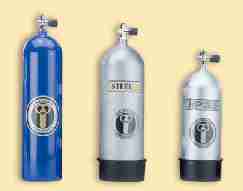
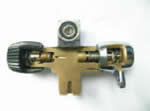
Good tanks, bad tanks and tanks that go ‘bump’ in the night!
SCUBA Cylinder Manufacturing Specifications & test standards are located in the dive technicians password protected area
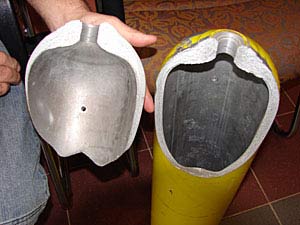
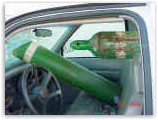
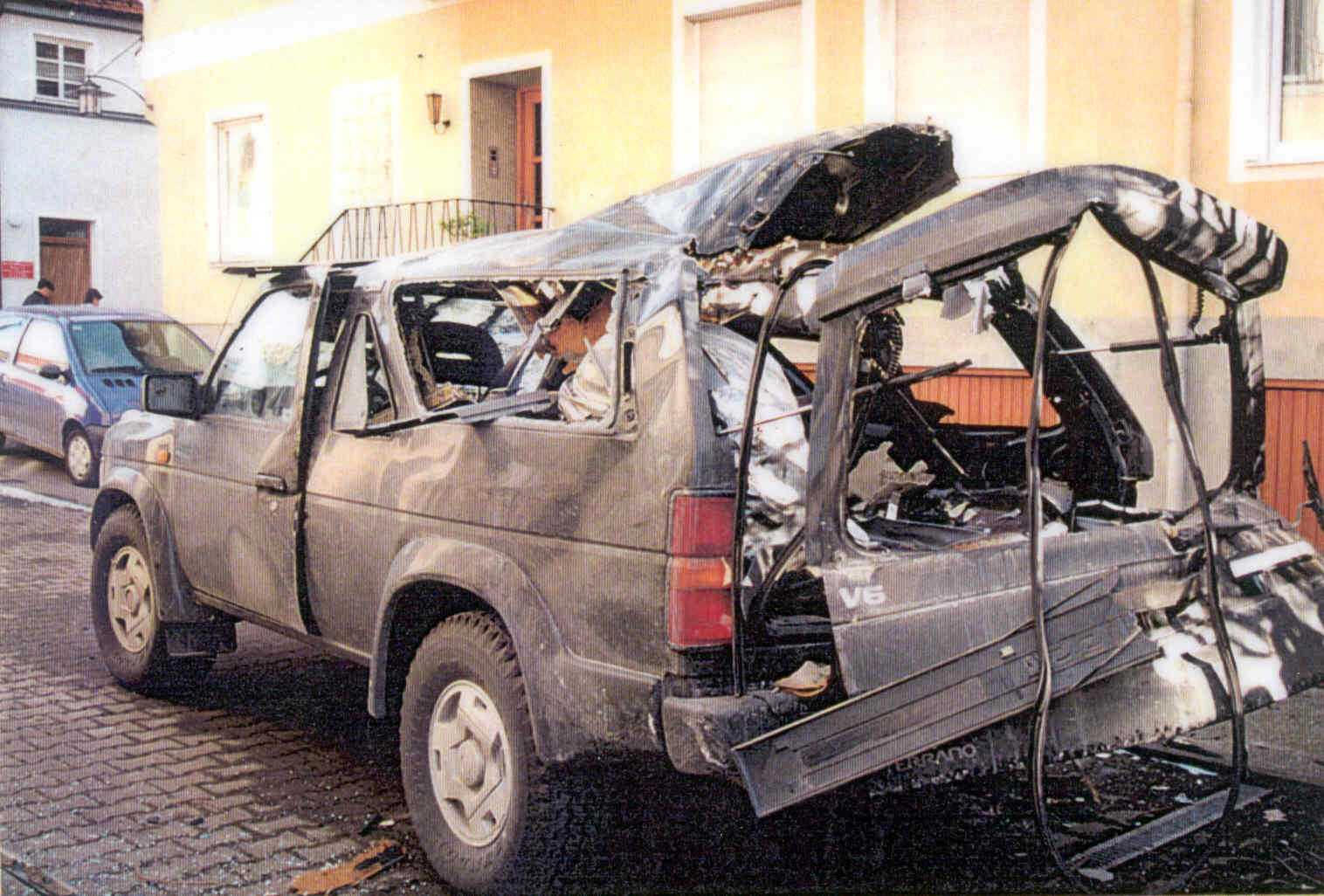
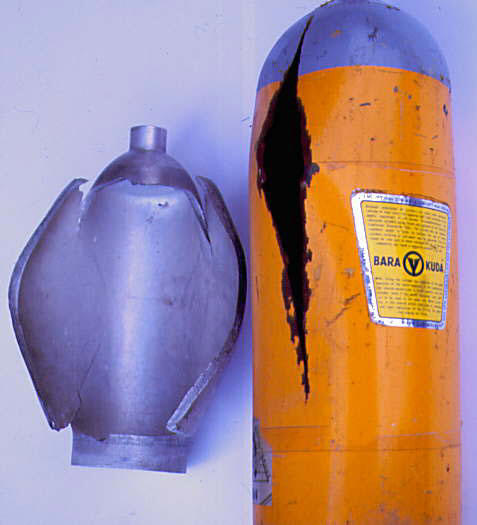
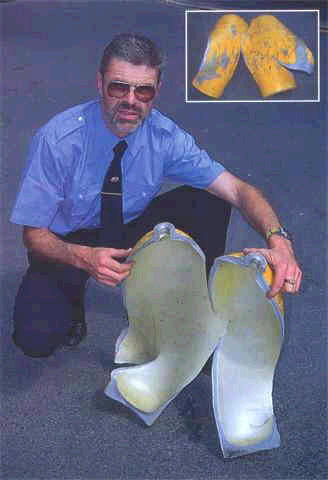
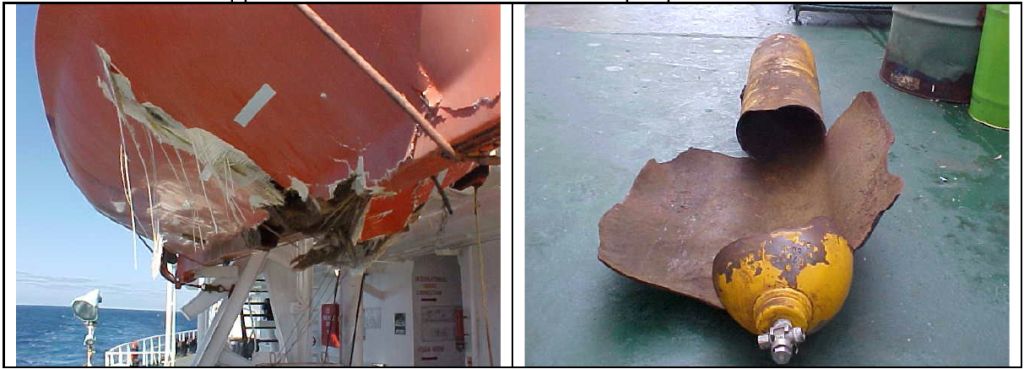
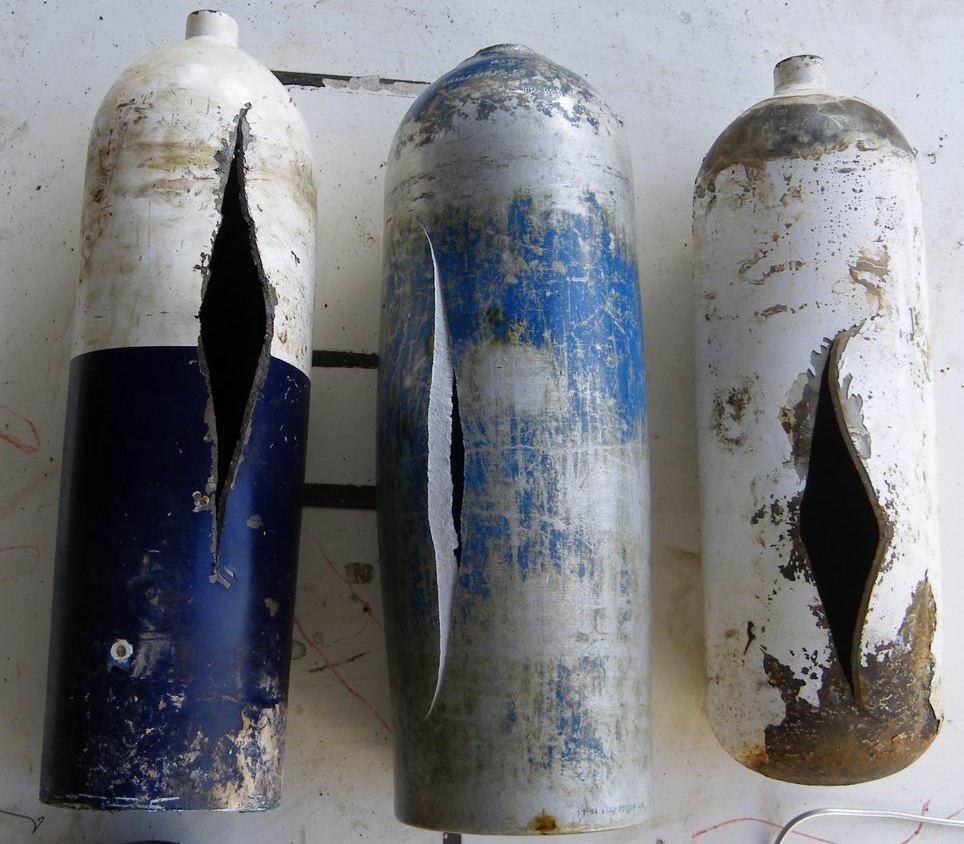
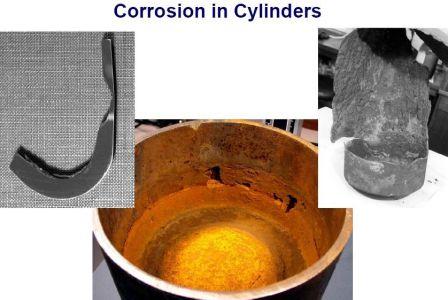
photo courtesy of the Asia Industrial Gas Association http://www.asiaiga.org/

Download the full AIGA report AIGA cylinder incidents.pdf 3.4Mb here.
Click here to book your ASSET High Pressure Cylinder Visual & Hydrostatic Inspection Training Course
—+++—
Dangerous Valve Conversion attempt (below) Metric M25 to USD DOT 3AL3000 3/4 x 14tpi NPSM
JB-Weld 2-part quick set epoxy used to glue a custom brass thread sleeve onto a machined valve body
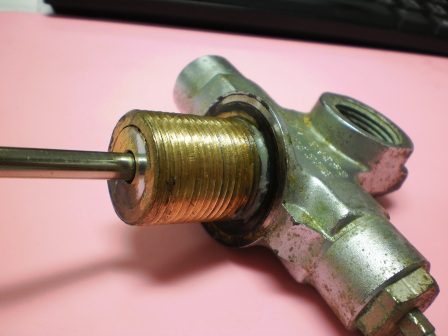
photos above – The owner actually used the valves in this condition, pressurized to 3,000 (1 ton per square inch pressure)
‘TRAINING TO SERVICE SCUBA TANKS
The skills and information necessary to safely inspect and test high pressure scuba tanks are learnt by attending the following ASSET approved courses.
Cylinder Testing Course – Level 1 (Practices and Procedures – VISUAL INSPECTION)
Cylinder Testing Course – Level 2 (Metallurgy, Inspection and Determination – HYDROSTATIC INSPECTION)
The best free handbook available for the guidance of personnel involved in the visual inspection of DOT 3AL3000 scuba cylinders is the Visual Inspection Guide produced and made available free of charge by the Luxfer company. You may download it here (see below). Please check the Luxfer site from time-to-time for a more recent download. There is plenty of other hard to find useful info listed here
- Download Luxfer DOT3AL Visual Inspection Guide(English) – new version with extra photos.pdf (1.42Mb)
- Degradation of Carbon Fiber-reinforced Epoxy Composites by UV Ultraviolet
Radiation and Condensation - Luxfer_technical seminar QA Clarifications.pdf (236Kb)
- United Kingdom H SE Guide to ‘Safe Use of Scuba Tanks’ (192Kb)
- Luxfer Manufacturing halt dates for T6351 Alloy (USA).pdf
- Download German language tank testing information “flaschen_und_Ventile” (12.2Mb)
- Catalina Tank Valve Insertion Instructions .PDF (30Kb)
- Thermo Valve Maintenance Instructions.pdf (1.08Mb)
- Offshore compressed air cylinder explosion report .pdf (143Kb)
- high pressure hose connectors from f oster_couplers_2004.pdf (1.9Mb)
Inspectors comments The CGA Grade ‘E’ divers breathing air standard water content specified as a dew point doesn’t match the read-out units for water content in mg/m^3 as displayed on the industry standard Draeger tubes. Conversion from dew point to mg/m^3 is possible, but there is still much confusion in interpreting the CGA moisture content specification – (many operators ignore it completely!). With such an ambiguous breathing air specification, it guarantees the sort of corrosion shown in the photos above and below. EN12021 can also be difficult to interpret, with a different specification for the humidity content of breathing air dependent on the storage pressure.
Rusting caused by water in SCUBA/SCBA Tanks
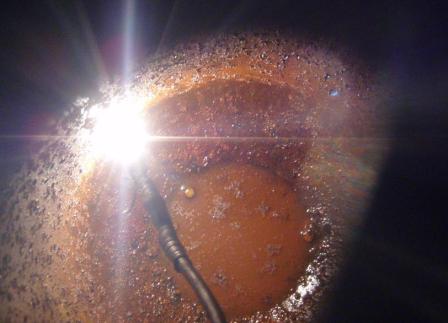 Primary cause – Breathing air compressor not maintained according to manufacturers recommendations
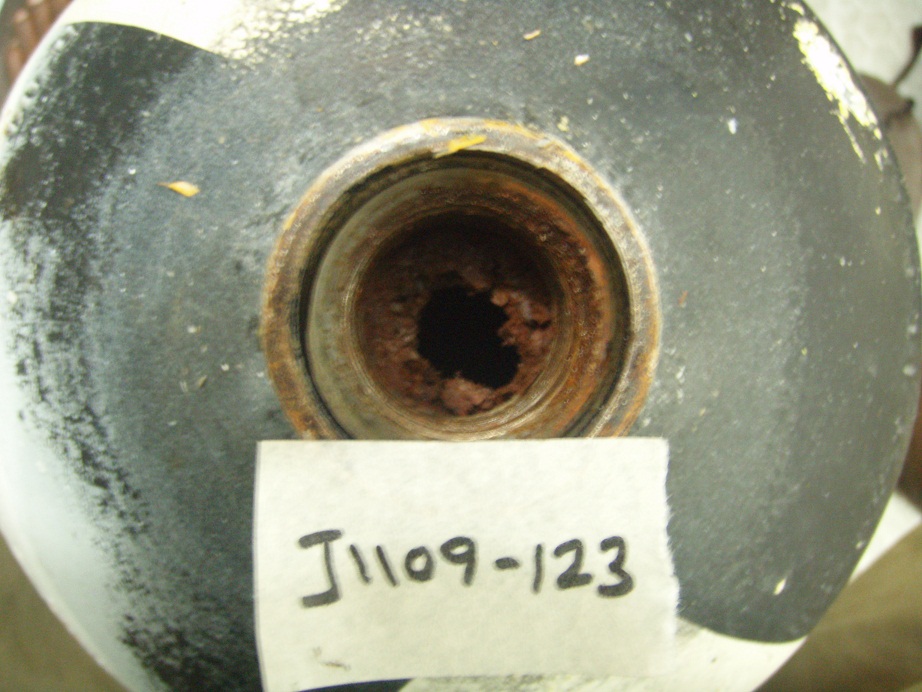
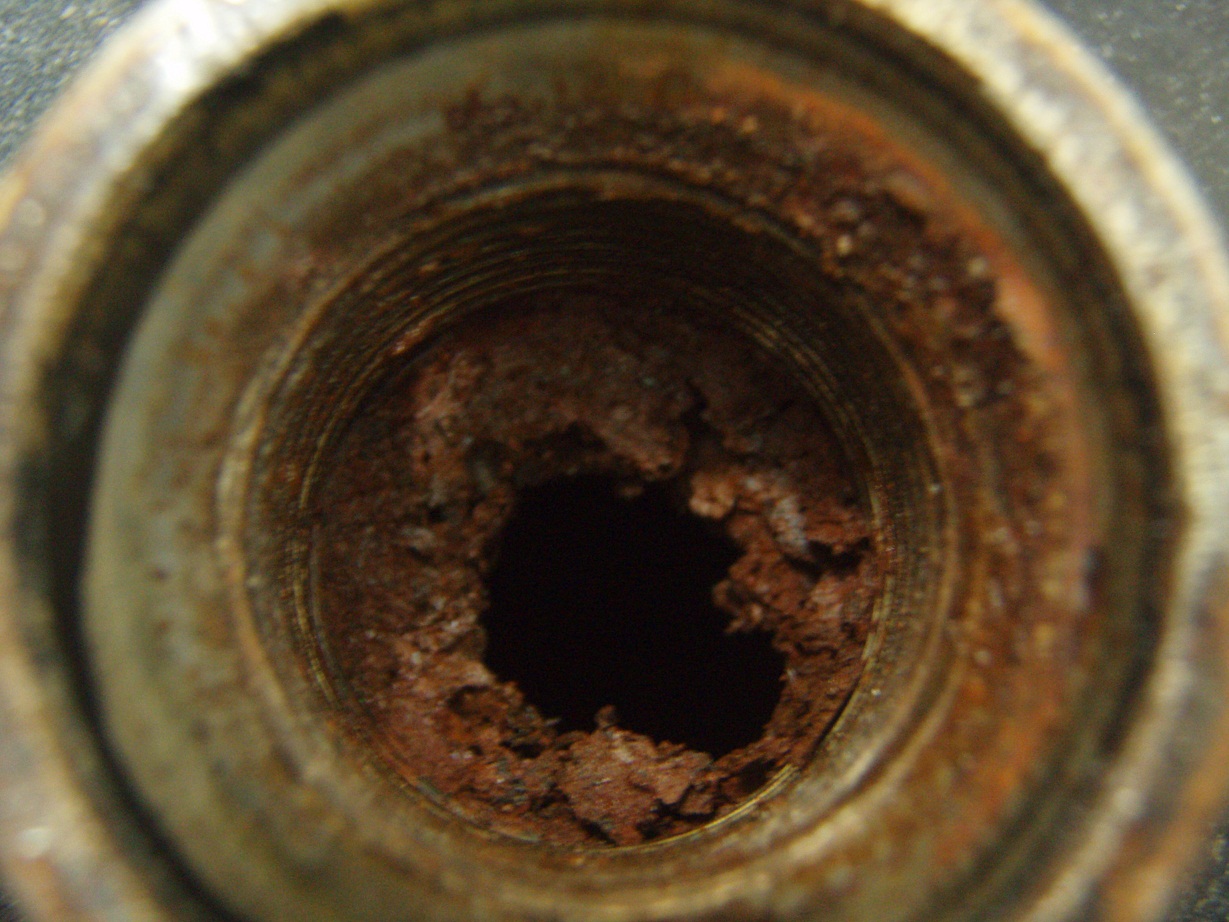
Be careful where you chose to have your cylinders filled. Only use breathing air providers that can show you an air test certificate completed within the last 90days by a respected 3rd party test house, and who use compressor log books to prove they are maintaining the compressor in accordance with the manufacturers published maintenance schedule.
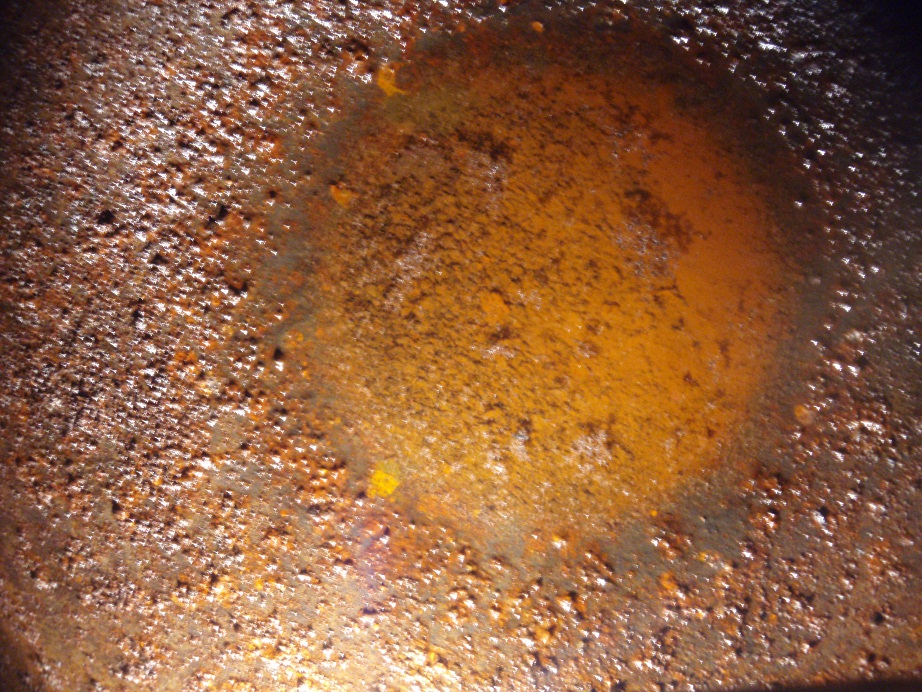
Evidence of previous water ingress into a steel cylinder that has subsequently dried out (see below)

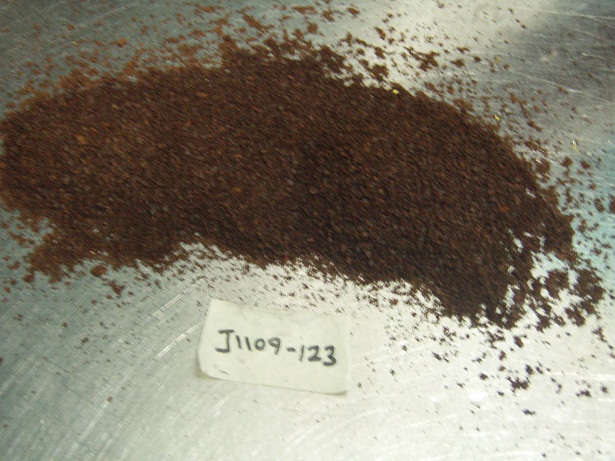
(click for hi res photo)
Rusting in Aluminium Cylinders (below) Evidence of previous water ingress into an aluminium cylinder
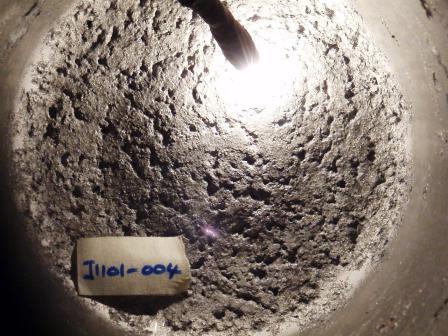
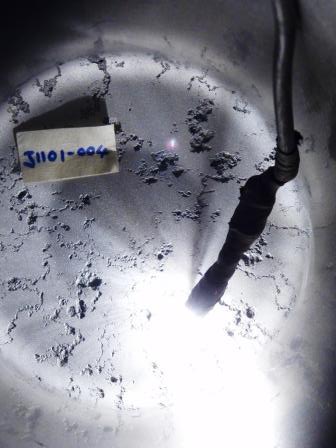
Before cleaning and after cleaning
Cleaning method “tumbling with ceramic media” half full, 30rpm, 2 hours cost USD15 Inspection result after cleaning ‘Fail; corrosion pits exceed maximum depth allowed by inspection standard’
Tank miss- handling
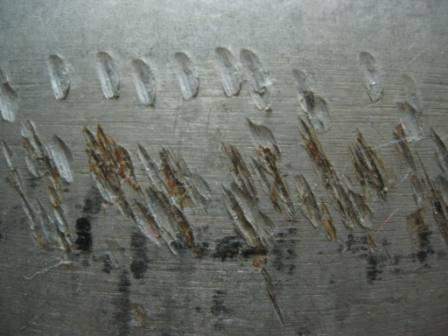
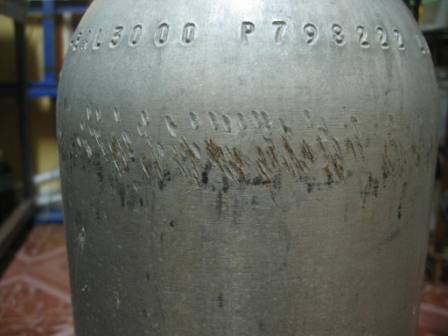
‘it fell through through the floor and rattled against the prop shaft…’
Need NDT Crack Detection for T6351 copper-aluminum alloy?
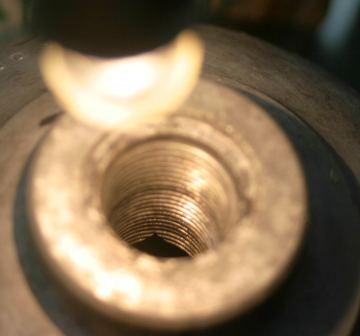
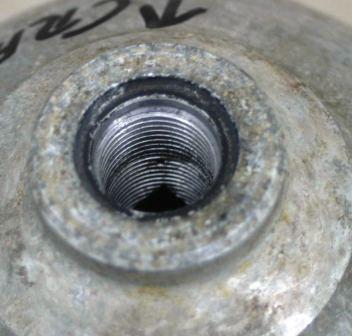

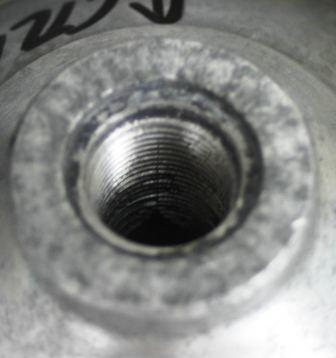
Visible Cracks in T6351 Aluminium Alloy SCUBA Cylinders – click for larger image
Try Visual Plus NDT by Advanced Inspection Technology

- visualplus_manual.pdf 1.8Mb
- DOT Eddy Current Final testing of T6251 Aluminium Alloy – Final Rule49-411928 2007.pdf
Example Visual PLus data files showing cracks:- VP3_file_cracks_03-02-2011_failed.vis , VP3_file_cracks_16-03-16-201_failed.vis view the above files with the free visual inspection software here.
Valleys and Folds?
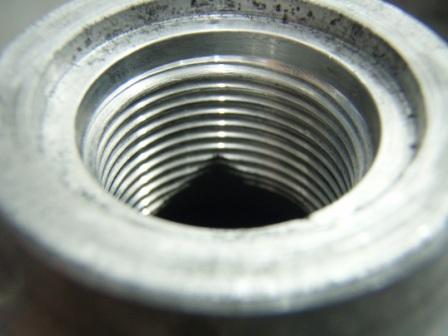 A smooth undulation into the thread area would be termed ‘a valley’ however, in this instance, the indentation forms quite an acute angle with a point, likely warranting the description ‘A fold’.
The above manufacturing defect extended deep into the important neck thread area of a DOT-3AL3000 (3,000psi/207bar) Aluminium Cylinder. A good candidate for a thread microscope and NDT inspection to check for cracks. Note:- The Luxfer Visual Inspection Guide calls for 8 defect free threads starting from the top for a 3,000psi cylinder. This cylinder would not meet this pass/fail criteria.
How Bad can corrosion pits get ?
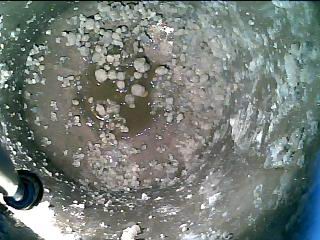
Presenting(below) – A scuba tank that not even a Yemeni Bedouin compressor operator straight off the camel would fill…
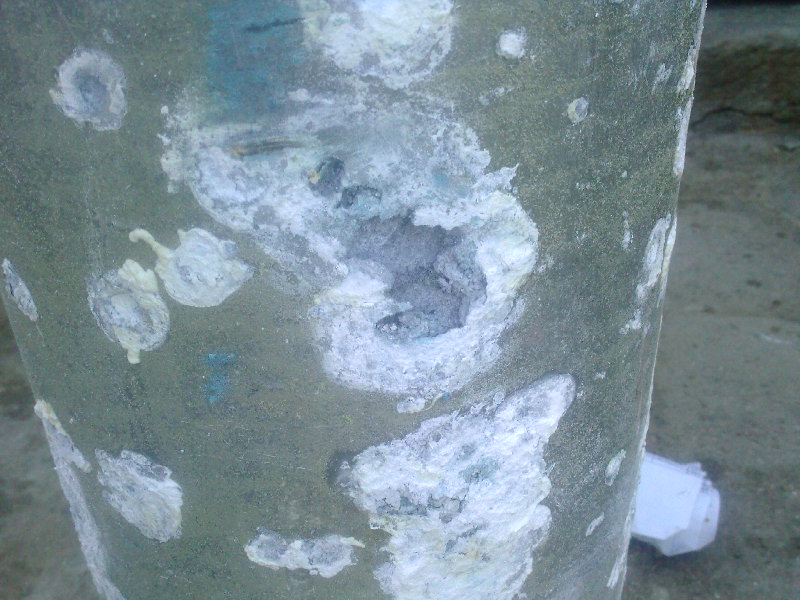
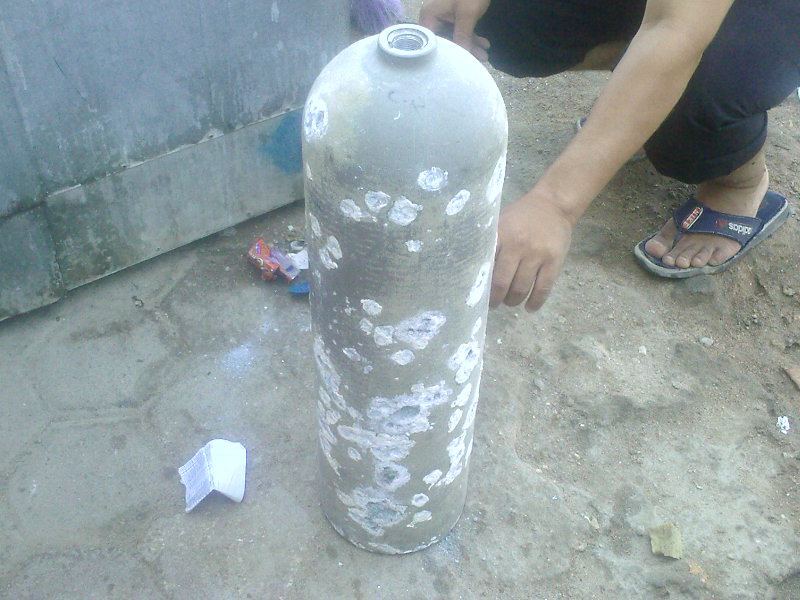
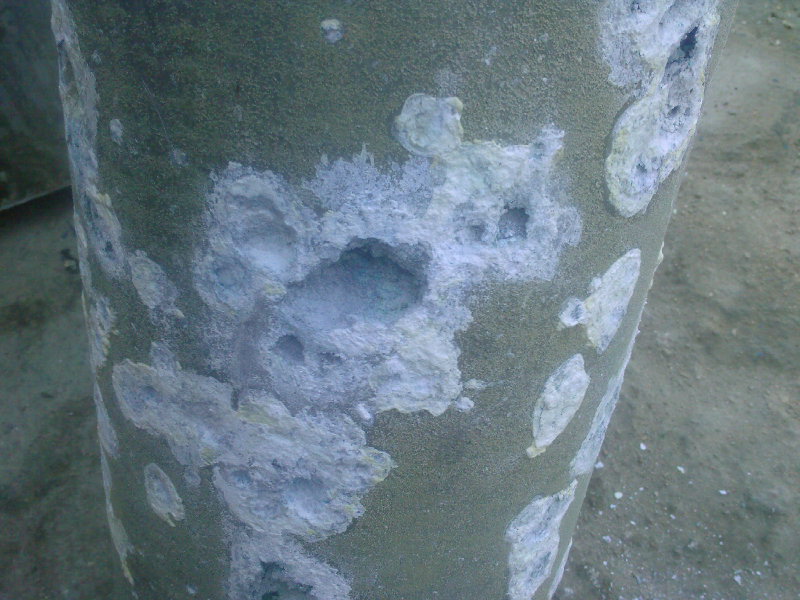
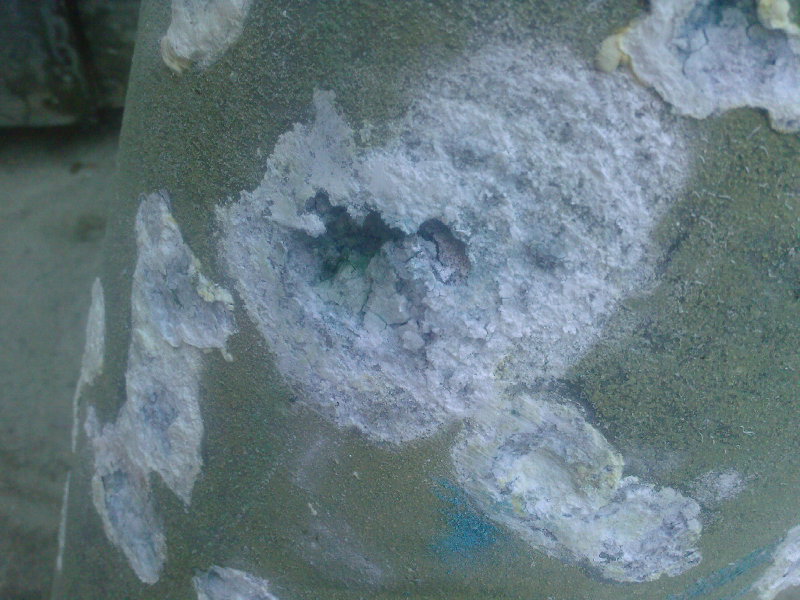
Internal corrosion pits – somewhere in a dive center near you in Asia under those corrosion bi-product mounds will be pitting deep enough to cause the cylinder to fail inspection.
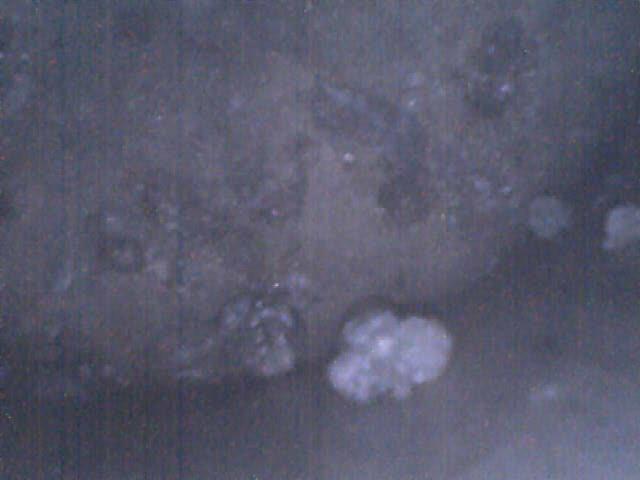
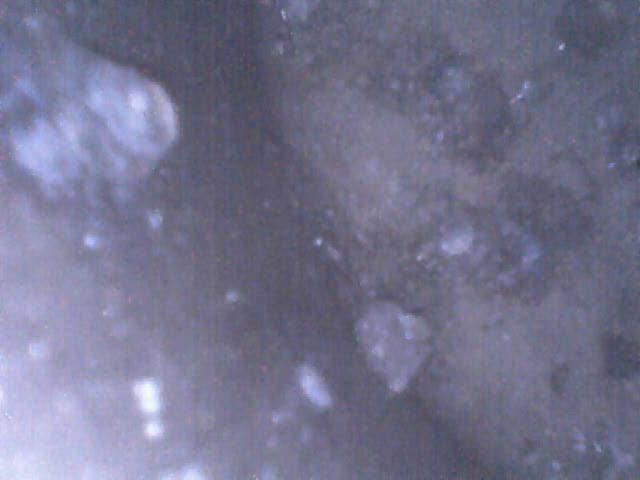 Despite diver training agency rules, less than 1% of all dive centers in this popular dive destination with 600 dive centers carry out the required air purity testing. Local governments don’t have the resources to police it. The training agencies don’t want to rock the boat and enforce their own rules, potentially causing dive centers to offer another less stringent agencies training products and loose their lucrative registration fees.
Thinking of storing SCUBA Cylinders on Dive Boats? Not Recommended Since manufacturers recommend that you ”Wash your cylinder in fresh water and dry after each use’ it is difficult to imagine a worse environment to store two products made of dissimilar metals in contact such as aluminium alloy SCUBA tank and brass valve together in a salt spray environment that exists on an open dive boat. For most dive operators this is of cause unavoidable; just be aware that storing cylinders exposed to salt spray will quickly cause external corrosion that will cause it to fail visual inspection due to external corrosion pits relatively early in its design life. See below for examples.
Luxfer SCUBA Cylinder care Leaflet.pdf 300Kb
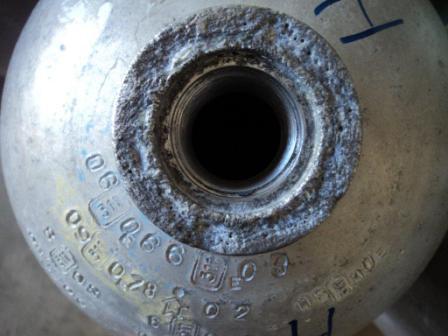 Aluminium SCUBA Cylinder ‘face corrosion’ caused by storing the scuba tank with a brass valve on an open dive boat. Inspection decision= ‘Condemn’
Note #1:- that most countries DO NOT permit any re-machining of the cylinder neck in an attempt to correct this issue by re-establishing a new o-ring grove and face surface.
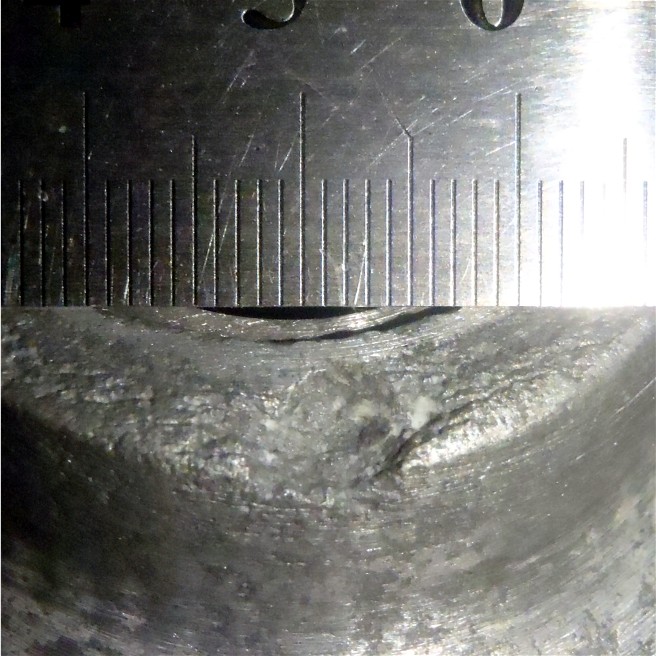 2nd example of severe face corrosion – nearly into the o-ring grove. Inspection decision= ‘Condemn’
Note #2:- It is may be possible to remove light/superficial ‘face and o-ring grove corrosion’ by careful use of a facing tool such as the Visual Plus O-ringer(see details below)
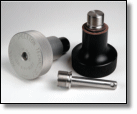 Visual Plus ‘ORINGER’ Brochure.pdf The use of this tool is approved by Luxfer & Catalina
Introduction to high pressure cylinder SCUBA tank testing regulations
1. American DOT-3AL3000 Cylinders
In America, the standards for testing high pressure cylinders are developed by the CGA (Compressed Gas Association) in conjunction with DOT (Department of Transport). The relevant CGA copyrighted specifications are listed below and are available for download here (from the CGA web site) .
Test stations applying for DOT approval must have their own individually licensed copies of the CGA documents needed to carry out the cylinder inspections the test station offers.
Note:- That the CGA charges fees for each downloaded document. A handful of documents may well cost you a few hundred US$
- C-1 Methods for Hydrostatic Testing of Compressed Gas Cylinders
- C-6 Standards For Visual Inspection Of Steel Compressed Gas Cylinders
- C-6.1 Standards for Visual Inspection of High Pressure Aluminum Compressed Gas Cylinders
- G-4 Oxygen
- G-4.1 Cleaning Equipment for Oxygen Service
- G-4.3 Commodity Specification for Oxygen
- G-6.2 Commodity Specification for Carbon Dioxide
- G-6.3 Carbon Dioxide Cylinder Filling and Handling Procedures
- G-7 Compressed Air for Human Respiration
- G-7.1 American National Standard Commodity Specification for Air
- G-8.2 Commodity Specification for Nitrous Oxide
- P-1 Safe Handling of Compressed Gases in Cylinders
- P-2 Characteristics and Safe Handling of Medical Gases
- P-5 Suggestions for the Care of High Pressure Air Cylinders for Underwater Breathing
- P-14 Accident Prevention in Oxygen Rich and Oxygen Deficient Atmospheres
- P-2.5 Tran filling of High Pressure Gaseous Oxygen to be Used for Respiration
- PS-7 CGA Position Statement of the Safe Transportation of Cylinders in Vehicles
- SB-7 Rupture of Oxygen Cylinders in the Diving Industry
- CFR Title 49 Parts 100 to 185
- CFR Title 21 Parts 200 to 299
- The current approved USA DOT testers listing is given here http://hazmat.dot.gov/sp_app/approvals/hydro/hydro_retesters.htm
- Special Notes for Fill Station operators DOT-3AL3000 Cylinders
- No cylinder can be filled with altered markings. Condemned DOT Cylinders have the ‘DOT’ and the pressure ratings ‘X’d out
- Only cylinders with approved burst disks may be filled
- Only aluminum cylinders marked ‘3AL’ may be filled.
- All the cylinders below must be removed from service
- SP890 , SP6688 , E6688 , SP6576 , SP7039 , E7235-4500psi
- All cylinders marked below cannot be filled until they have been tested by a hydro facility, NDT tested, and over stamped with ‘3AL’. Also note:-
- That these older cylinders are made of the troublesome T6351 aluminum alloy.
- The alloyed used in these cylinders has well known susceptibility to Static Load Cracks (SLC)
- They have caused several catastrophic explosions and the deaths of many cylinder fillers.
- They are subject to 4 monthly visual inspection periods if in heavy use such as at a dive school
- SP6498 , E6498 , E7042 , E8364 , E8422
An example of a ‘dodgy’ cylinder thus marked is DOT-E6498-3000. This marking should make you instinctively reach for your NDT tester if it ever graces your test bench.
Thread Form Testing
- Identifying the need to carry out Thread Form testing of DOT 3AL3000 cylinders using a Thread Gage
- The US CFR law calls for the DOT 3AL3000 cylinders to be inspected to CGA-C6.1
- The latest CGA-C6.1-2006 calls for the thread form to be inspected and verified ‘to have the specified number full threads of proper form as required in the applicable thread standards every time the valve is removed’
- The applicable thread standard for the 3/4 x 14tpi NPSM thread used in the DOT3AL3000 cylinders is ANSI/ASME B1.20.1 – 1983. This calls for the thread form to be verified with a thread gauge
- The gauging methods standard describing how to use a thread gauge is ANSI/ASME B1.2-1983, and calls for a maximum of 3 turns to be allowed on the thread gauge used for internal threads.
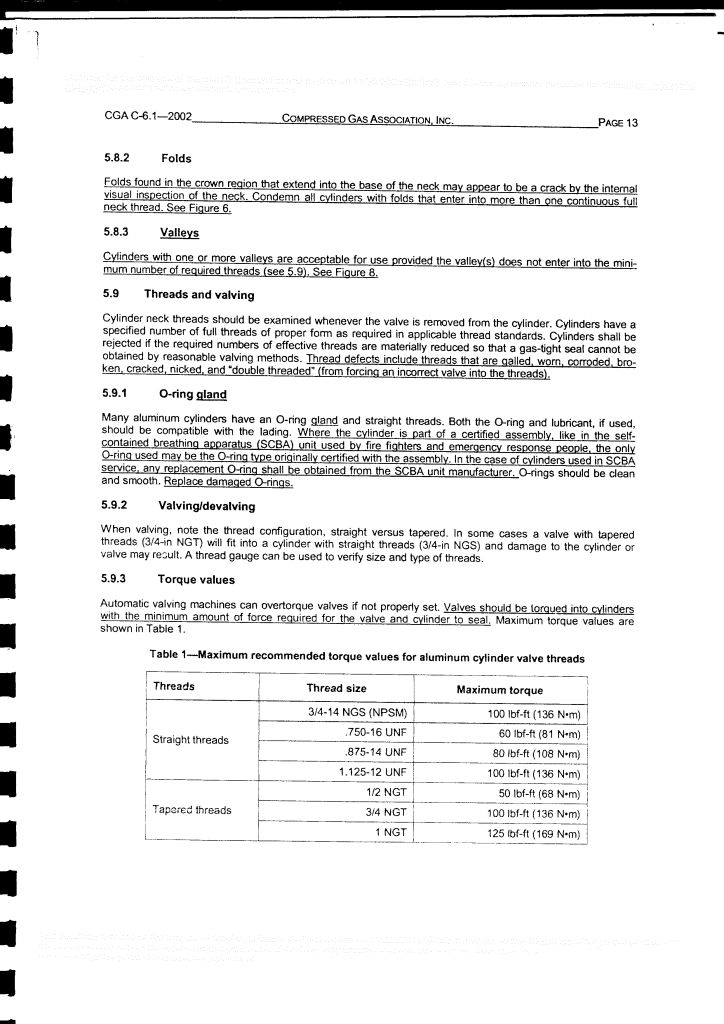
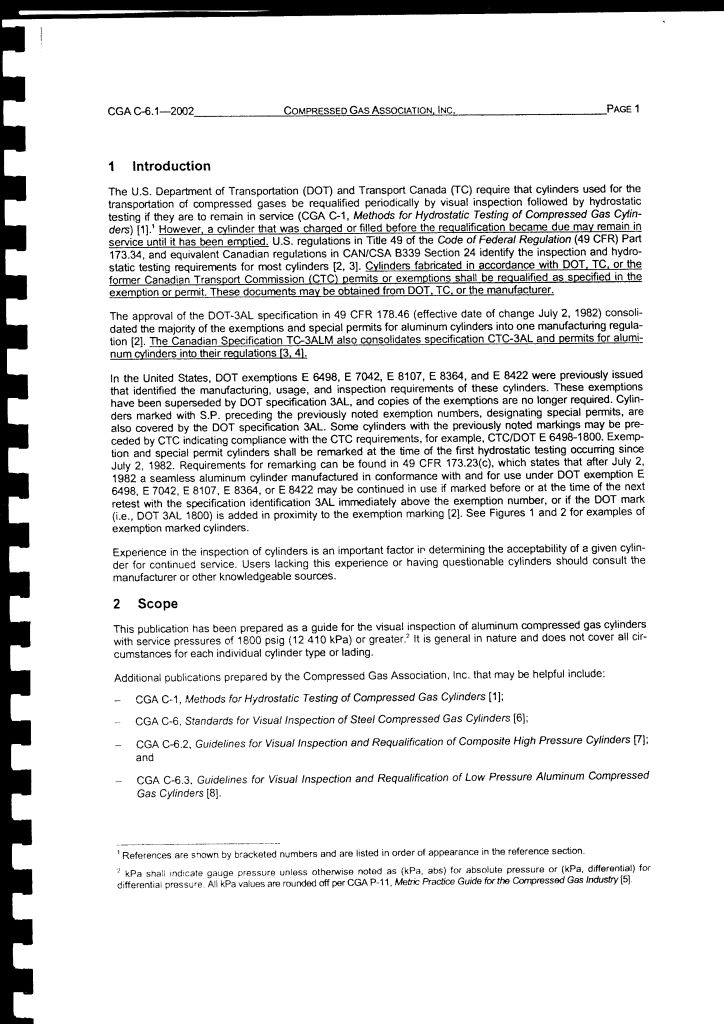
- Extract from the latest CGA C-6.1 (Copyright & Courtesy of http://www.cganet.com/ ) To download your own original licensed copy of the full CGA C6.1 follow this link http://www.cganet.com/customer/publication_detail.aspx?id=C-6. 1
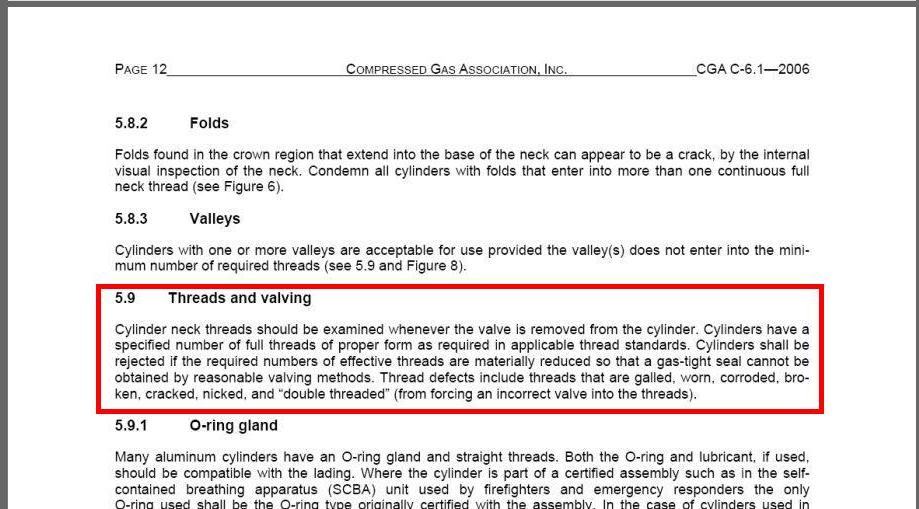
- Special Publication Note Dec 2007 – Gauging NPSM 3/4 threads. Clarification statement for ASSET members CFR49 part 171 – General Information, Regulations and definitions – DOT NPSM thread gauging
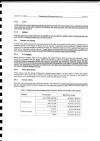
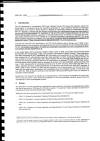 Extract from CGA C6.1 standard ‘threads must be of proper form according to the thread standards’ Thread_standard_npsm_tolerance.pdf
 - [Code of Federal Regulations 171.2] [Code of Federal Regulations 178] [Code of Federal Regulations 180]
- Identifying the need gauge DOT 3AL3000 threads CFR Thread Testing References thread_standard_npsm.pdf thread_standard_npsm_tolerance.pdf
- threadcheck_catalogue.pdf
- dynamics-of-gaging-complete.pdf iso_metric_plug_gauges.pdf plain_gauges_limits_and_fits.pdf Straight Pipe Thread Plug Gages
- thread_pitch_diameter_standards_reference.doc
H28_thread_standard.zip Luxfer Valves Thread gauging Instructions
2. European Cylinders
The European standards for the manufacturing and inspection of high pressure solid metal cylinders is as follows:-
- BS-EN1964 ‘Transportable gas cylinders. Specification for the design and construction of refillable transportable seamless steel gas cylinders of water capacities from 0,5 litre up to and including 150 litres’
- BS-EN1968 ‘Transportable gas cylinders. Periodic inspection and testing of seamless steel gas cylinders’
- BS-EN1975 ‘Transportable gas cylinders. Specification for the design and construction of refillable transportable seamless aluminium and aluminium alloy gas cylinders of capacity from 0,5 litre up to 150 litre’
- BS-EN1802 ‘Transportable gas cylinders. Periodic inspection and testing of seamless aluminium alloy gas cylinders’
British ‘BS’ & European ‘EN’ standards can be purchased online here
Cylinders should me marked in accordance with EN1089 and have labels indicating their gas contents and ‘hazard diamonds related to the gas contained therein.
SCUBA Cylinders are visually inspected every 2.5 years and hydro-tested every 5 years. Both the VIP & Hydrotest Inspection ‘pass’ is marked onto the cylinder neck by stamping for solid steel and aluminium types.
Newer cylinders will be painted with black-white quadrants on the neck to signify ‘breathing air’
Older aluminium cylinders (particularly older copper-aluminium types manufactured prior to 1995) may have significantly reduced inspection periodicity especially those in heavy use. They may also be subject to Magnetic Eddy Current NDT testing.
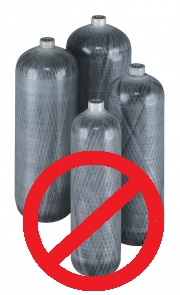
Many fibre-wrapped fire fighting SCBA cylinders are limited lifetime types and can be used for only 15 years or 3 hydro-tests.
SCUBA Cylinder Manufacturing Specifications for testing to BS/EN/CGA limits Located in the technicians password protected area – <click here to download>
Click here to book your ASSET High Pressure Cylinder Visual & Hydrostatic Inspection Training Course
3. Thailand
Thailand represents one of the largest and fastest growing scuba destinations world wide, and has good legislation in place for the testing high pressure cylinders.
Relevant Standards effecting compressor operators and high pressure cylinder users are listed online here:- http://www.tisi.go.th/standard/cat_eng.html
- TIS 358-2551 (2008) Use and maintenance of compressed gas cylinders
- TIS 88-2517 (1974) Identification colours and marking for industrial gas cylinders
- TIS 359-2530 (1987) Pressure gas cylinders, seamless type
- TIS 1095-2535 (1992) Medical gas cylinder valve connections
- TIS 642-2529 (1986) Rubber hoses for compressed air
Sadly, lack of effective legislation and enforcement of not only the cylinder inspection standards but also divers breathing air standards by PADI in Thailand leads to most dive centers pumping scuba air that does not meet international divers breathing air standards.
ASSET technicians working in this region are reporting near 100% of all scuba cylinders supplied for re-testing from recreational dive centers are suffering from extensive internal corrosion, plus nearly all compressors supplied for service/repair from Dive centers have non functioning or incorrectly set Pressure Maintaining Valves (PMV) – The single most important component of the compressor responsible for removing moisture from the breathing air, and the starting point of creating EN12021/CGA Grade-E divers breathing air.
TIS (Thai Industrial Standards) booklet TIS 358-2531 (1988) ” Standards for use and maintenance of compressed gas cylinders” ISBN-974-8112-29-2 u ses hydrostatic methods similar to that used in USA, European and UK standards.
This booklet is currently only available in Thai language (click image below to download).
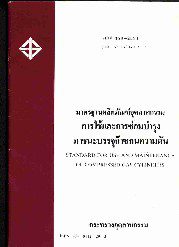
Older(obsolate) Thai Industrial Standard 358-2531 (ISBN 974-8112-29-2) 1.6Mbyte
Key points from this standard voice a ‘3 year’ periodicity for hydrostatic testing, and that condemned cylinders must be ‘cut in half’ to prevent them from being used again.
Sadly, given the size of the Thai recreational Scuba Market consisting of more than 600 Dive Centers, this test standard is almost unknown, and government enforcement of it’s procedures within the recreational scuba industry is practically non-existent.
Uneducated fools, usually from a sales back-ground hawking dodgy cylinders have been heard to state, “Their is no requirement to test scuba cylinders or inspect high pressure air hoses in Thailand…” & “there is no requirement to check the thread form of the valve and cylinder neck when refitting valves”. Resulting in the following typical calamities:-
- Valve ejected (mismatched thread) Mae Haad, Koh Tao, Thailand 2006. Dive shop compressor room damaged, Roof holed. cylinder valve presumably still orbiting earth… mix up with valve threads 3/4 NPSM and 3/4 BSP(F)
- Dive Instructor leg nearly amputated by ejected valve. Mae Haad, Koh Tao, Thailand 2005. Cylinder went through 2 concrete walls and landed on a tourist beach bungalow… Instructor did not ‘proof test’ cylinder empty before attempting to remove valve.
- Valve ejected during filling, thread failure, Chalong, Phuket, Thailand 2002. Dive boat sunk. Compressor safety valve welded up. Bursts disks in cylinders replaced by solid bolts.
- Filling hose failure, Pattaya, Thailand 2006. Dive Instructor severely injured when hose hit his face. Wound exposed jaw bone. 14 stitches to close the wound. Cause unknown
A comprehensive examination of the different International techniques outlined above is covered during the ASSET Cylinder Inspector Pt1 & Pt2 course training.
Click here to book your ASSET High Pressure Cylinder Visual & Hydrostatic Inspection Training Course


Both the manufacturers above have excellent web sites contain the latest up-to-date information and news on scuba tanks.
PAINTBALL Cylinder Inspection Information
Fibre Wrapped High pressure cylinders
- paintball_usa_carbon_composite_cylinders.pdf 361Kb
- dot_cffc_5th.pdf 69Kb
- dot_e_10915.pdf 187Kb
- luxcompinspectmanual.pdf 4.3Mb
DIY Hydro test Rig manufacturing Information
Training in Visual inspection plus the required test equipment and tools is relatively inexpensive to obtain. However, hydrostatic test rigs costs are very expensive and cost around US$15,000 minimum.
If you have the formal engineering skills and fancy building your own hydro rig for a fraction of the cost.
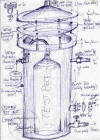 Download the engineering drawings for a scuba tank hydrostatic test system here
Unusual DOT3AL3000 Threads ‘Condemn’ Thread corrosion that has propagated along the grain boundary.
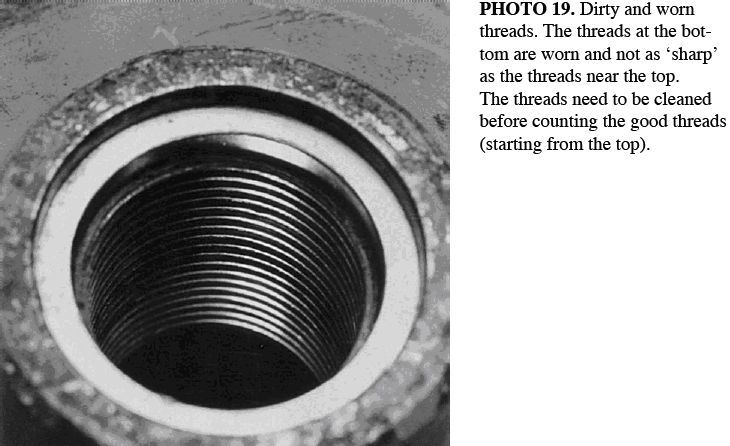
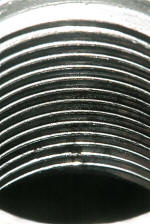 INSPECTORS NOTE – The problem above (left hand photo) is absolutely not visible from the small thumbnail above in any way Click on the image to download a high resolution 400Kb Photo to view the problem running along every thread. The right hand photo is presented from the manufacturers inspection guide. This is a really difficult inspection call and often requires a manufacturers decision.
Manufacturers Comments The (high resolution left hand photo) appears to me to be corrosion that has propagated along the grain boundary. I have seen many times in scuba where corrosion will begin between the 8th and 12th thread of the cylinder, at the exact location where the valve ends in the cylinder. This is most likely due to the moisture that sits at the junction between two dissimilar metals. The corrosion is greatest in the grain boundary, inter-granular corrosion, and propagate along the grain. The grains predominately run perpendicular to the axis of the threads and when attacked by corrosion can appear as linear indications similar to folds or cracks – but are not. It appears in the second picture that some metal is missing in the 11th thread – a condition typically associated with corrosion, never a crack. In checking a cylinder with an eddy current device usually a 2 thread indication is reason for reject. This cylinder may be rejected for a linear condition, corrosion, that extends more than 2 threads but it is not rejected for a manufacturing defect.
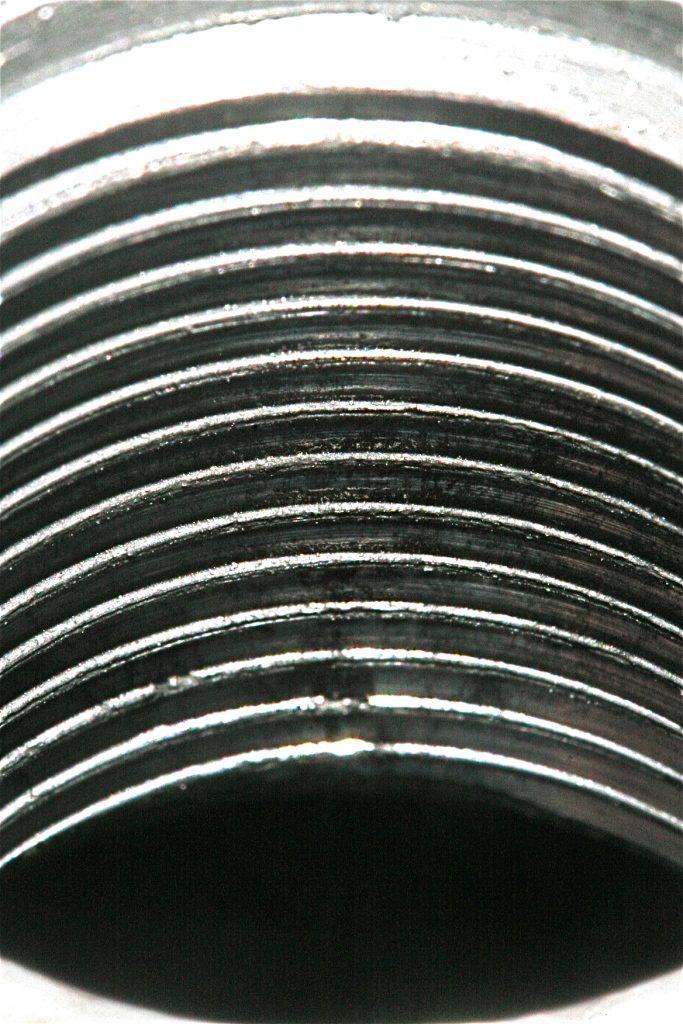
Manufacturer Decision:- In a case like this we would offer our replacement program to the owner of this cylinder.
Worst Corrosion every seen on DOT3AL3000… (unless you have seen worse…)
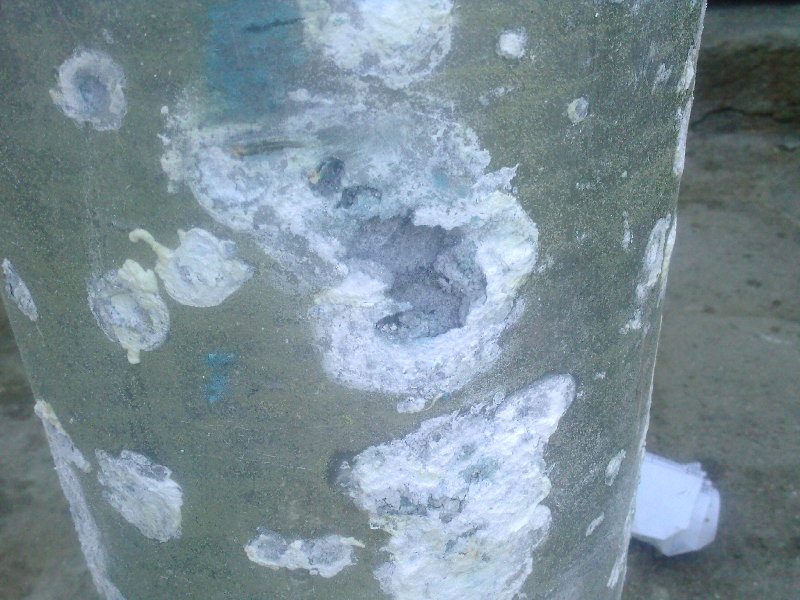
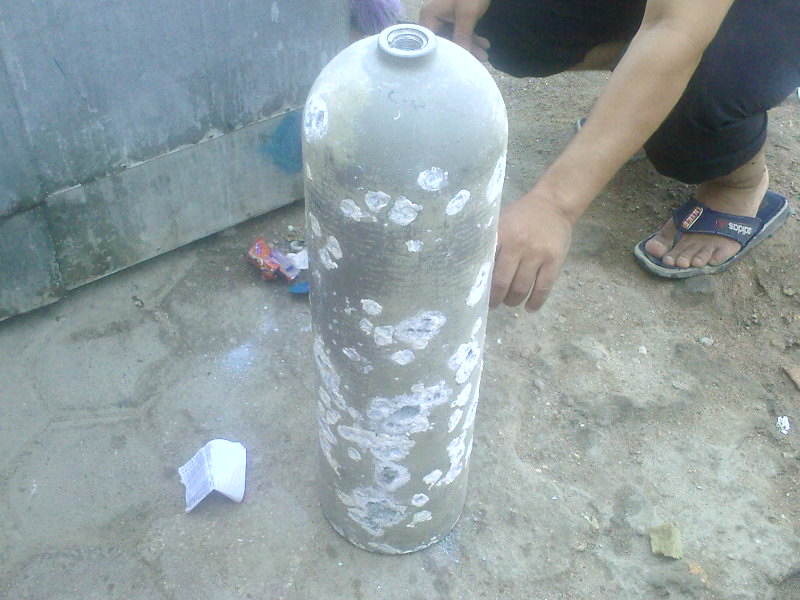
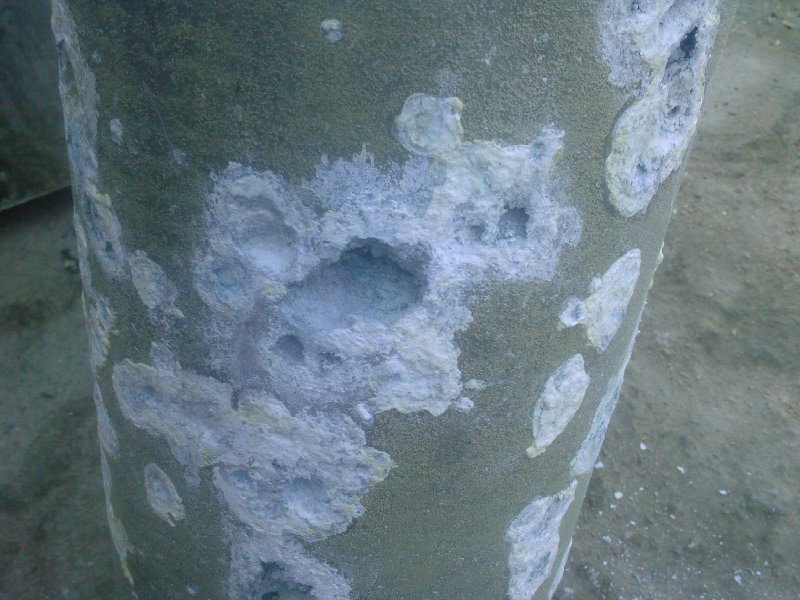
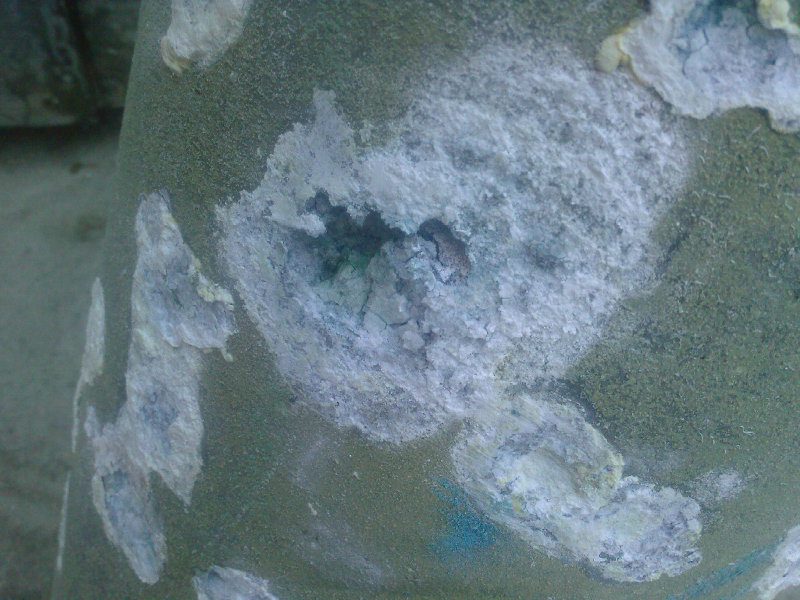
Click each image for Hi-Res 135Kb image
Inspectors comments “Even my Yemeni goat herdsman employed as a tank filling boy refused to fill this one”
‘Tanks by mail Disaster’
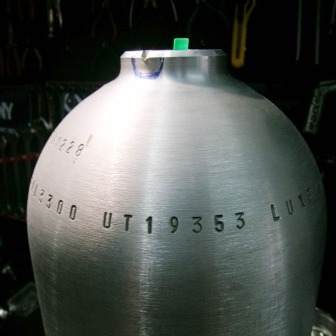
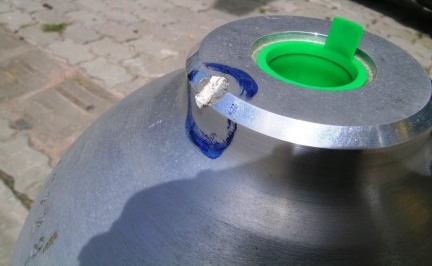
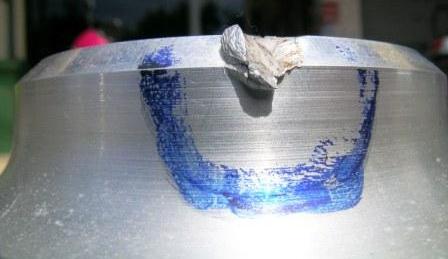
Click image for Hi-Res 100Kb image
Inspectors Comments Damage to critical neck and face region. Depth of gouge exceeds inspection limits; Decision=Condemn. Manufacturer 2nd opinion=Condemn.
Chinese commercial Cylinders – coming your way soon
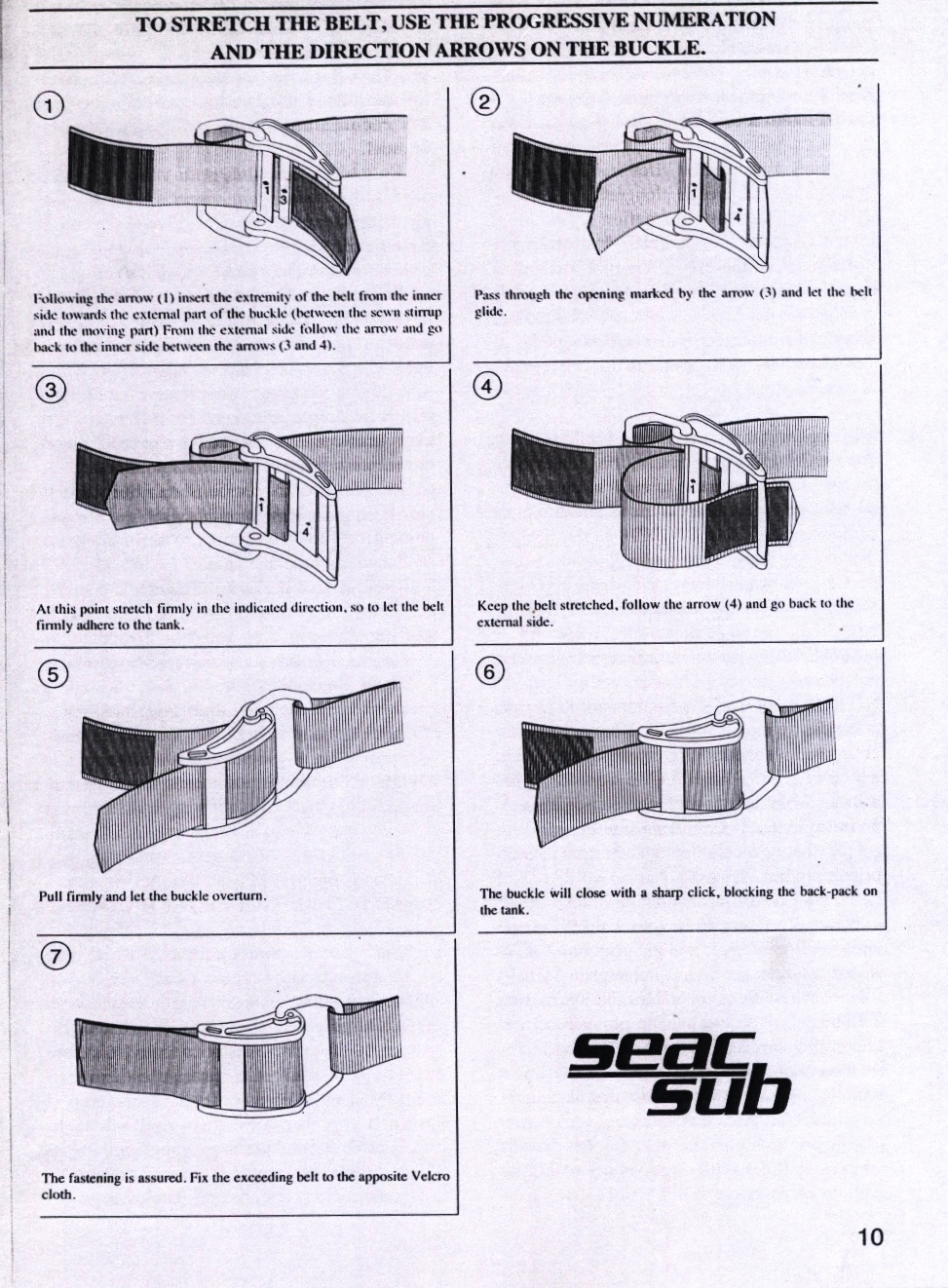
” and the answer to the perennial Divemaster Question… How do you re-thread a tank strap onto a BCD Buckle “
This has kindly been answered with a very clear series of pictures by the nice folks at SeacSub
Click here to book your ASSET High Pressure Cylinder Visual & Hydrostatic Inspection Training Course
The necessity for compressed gas cylinders to be tested and approved when transported by road (in accordance with the CGA regulations) is enshrined with US law within the Code of Federal Regulations