
How to avoid a Isobaric Counter Diffusion hit
or…a simple visualization for determining the tolerable increase in inspired nitrogen percentage during the decompression phase of Trimix dives.
Author: Steve Burton, Pattaya, Thailand. December 2004 (Rev: 2011)
Comments to:- deepdive@loxinfo.co.th or www.scubaengineer.com
Background Type III DCS caused ICD is predominantly a problem that occurs when carrying out Trimix dives that are deep enough and long enough to generate formal decompression stops requiring the use of a hypoxic Trimix deeper than 40meters/130ft. An analysis program embodying these concepts to identify known unsafe ICD gas switching practices and unsafe decompression is made available here
Assumption Formal decompression can only be carried out safely when the TOTAL quantity of all dissolved inert gas partial pressures in a tissue compartment is less than it’s overall M-value. It is very important to view decompression of the Trimix diver in this manner to get an understanding of what’s going on with ICD.
The first thing to understand is:
Quantity of a dissolved gas in a saturated medium = Current saturation pressure x solubility factor in the medium
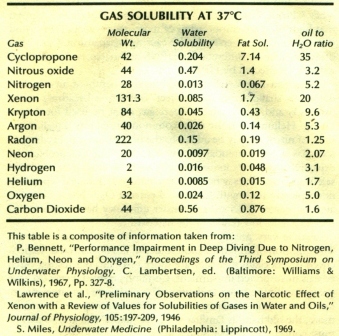
The Table below above lists the different solubility’s of gases in water, lipid tissue (Fat Sol.) and oil/H20 Ref:- Solubility factors from ‘Scuba Diving in Safety & Health by Chris W Dueker, MD) ISBN 0-9614638-0-5
For lipid tissues, the solubility factors of Nitrogen and Helium in Fat Sol. are are observed from the above table to be as follows:-
Solubility of Helium=0.015 , Solubility of Nitrogen=0.067
Note that the solubility of Nitrogen in lipid tissues is approx 4.5 times that of Helium
But, the diffusability (the speed the gas goes into and out of solution) will also come into the dynamics of the overall model. The speed of diffusivity of Helium is 2.65 times faster than Nitrogen.
So lets look at the aiming conditions by examining a gas switch at constant depth with the diver resting at the decompression ascent ceiling; switching from Trimix 20/25 to Nitrox32 at 40 meters depth.
These are the partial pressure ‘aiming points’ for the tissues in (bars)
| Depth | Ambient pressure | Trimix 20/25 | Nitrox 32 | ||
| 40m/130ft | 5 bars | pp-n2 | pp-He | pp-N2 | pp-He |
| 2.75 | 1.25 | 3.4 | 0 | ||
Although the sudden jump in ppN2 appears small, one must remember that the ‘aiming point’ for the TOTAL amount of dissolved gas in the tissue compartment is actualy as follows
Before switch
(2.75×0.067) + (1.25×0.015) =0.18425+0.01875 =0.203 eq(1)
Immediately after the switch
(3.4×0.067) + ( 0) =0.2278+0 =0.2278 higher than eq(1) !
Hence the effect of switching to Nitrox from Trimix has the effect of INCREASING the overall gas loading within the tissue since the loss of 25%helium is more than taken up by the increase in Nitrogen from 55 to 68%(13%). This is not a good thing if you happen to be sitting on the ascent ceiling at this time. This will cause an immediate fast tissue DCS Hit.
Conclusions
- Switching from Trimix20/25 to Nitrox32 at 40meters aims to increase gas overall tissue gas loading
- Since the solubility of Nitrogen is 4.5 times more soluble than Helium, Nitrogen percentage should never increase more than (say) 1/5 the reduction of the Helium percentage to keep the aiming point for the dissolved gases the same
This suggests a simple rule
The ICD-avoidance gas switching rule of 1/5ths ’
Necessary if carrying out formal deco on intermediate Trimix
| % Helium Gas reduction | Permissible % Nitrogen Increase |
| 10 | 2 |
| 20 | 4 |
| 30 | 6 |
| 40 | 8 |
| 50 | 10 |
| 60 | 12 |
| 70 | 14 |
| 80 | 16 |
| 90 | 18 |
This would suggest that if you were carrying out formal decompression stops on intermediate Trimix while sitting at the ascent ceiling that:-
A Switch fromTrimix20/25 to Nitrox 32 is NOT OK since Nitrogen jumps from 55 to 68% (a 13% jump), where the rule of 5 th suggests a maximum allowable increase in %Nitrogen for a 25% drop in Helium of only 5%.
However, A switch from Trimix 20/25/55 to Trimix 32/8/60 would likely be tolerated.
Key XX/XX/XX is Oxygen%/Helium%/Nitrogen%
Established gas solubility measurements dating back to research into the Myer-Overton theory of anesthesia (see chart above)together with established Haldanean decompression theory neatly predict this effect – however, it is likey that a far more complex macro model similar to that used to predict safe decompression is necessary to generate limiting tolerances of the human body to gas switch ICD for all gas combinations and decompression states occuring during ultra deep Trimix dives – However, the simple rules given above have been found to work well over hundreds of deep trimix dives and successfully avoid all the historical ICD cases that I have data for. Extreme testing of these rules successfully predicted Mark Ellyatt’s Gas choices and Helitrox decompression schedule for his 313meter Open circuit Trimix plunge a few years a go, and the then deepest ever wreck dive.
This dive represented the first successful use of ICD avoidance in an Open Circuit scuba dive to these depths by calculating the gas percentage change tolerable. Also, it was the first time that the diver carrying out a Trimix plunge to these depths didn’t spend his last 6 hours of deco puking on every breath. A desirable result…
Mark complained about the helium bill, but the savings mad in not having to complete succesive ‘USN-table 6 chamber rides’ at $5,000 a treatment more than compensated for the extra helium costs. Wonderfully, Mark was back teaching PADI ‘Discover Scuba Diving’ instead of his usual Discover Scary Drowning courses just a few days later.
The only other successful ICD avoidance technique I am aware of was used by late Sheck Exley’ by using ‘phased in switching of Trimix to Nitrox’. The technique is explained thoroughly in is book ‘Cavern Measureless to Man’ ISBN 0-939748-33-9 published by Cave Books 1994. I’ll give you Sheck’s ICD avoidance technique here for reference. Sadly, although Sheck is no longer with us, he plainly had an unusually good instinctive feel for what was going on in his body with regards to mixed gas effects and how to avoid them. Sheck realized that ICD was predominantly fast tissue event’
<EXTRACT>
‘CAVERNS MEASURELESS TO MAN’ Author:- SHECK EXLEY page 259
“At 260 feet and 250 feet… I counted sixty-second stops with my fingers, then addressed a new source of concern: Jochen and Gene’s mysterious vestibular hit. At 240 feet I had to switch from breathing 50 percent helium and 40 percent nitrogen to air, which contains 79 percent nitrogen. According to their information, the abrupt increase in nitrogen could result in instant death. And all authorities predicted a sudden onset of severe narcosis.
To make the switch as gradual as possible, I took only a single breath of air from the tank we had earlier left at 240 feet, then switched back to the helium mix for two breaths. Then came two air breaths, then back to the deep mix for one inhalation. Finally I switched over to air completely, bracing myself for the severe narcosis and dreaded vestibular hit, all the while doing my best to count off the seconds required for the stop. Nothing happened, no narcosis, no sudden lapse into unconsciousness. The only thing I felt was warmer, thanks to not having to breathe helium any more. Apparently my strategy of keeping a maximum amount of nitrogen in the deep mix worked.”
<EXTRACT ENDS>
Sheck’s dive plan for his 1989 dive to 881ft at Nacimiento del Rio Mante in Mexico, also follows and uncanny resemblance to what we now know to be a correct decompression profile for a Trimix dive to these depths. The only thing missing in his plan was a Helitrox decompression schedule.
I’ve put a copy of Sheck’s successful 1981 dive plan up on the web at for analysis purposes at Sheck Exley Mexico Dive
As to the time scales and diffusion dynamics, or what percentage change of gas can be tolerated over time (on a second by second basis) and at what depth? I’ll need a few weeks of uninterrupted thought to visualize it before I can hatch the math for the time dependent exponential math matrix that’s generating these effects. All I have at the moment is a feel for what’s going on. But it’s a start.
My feeling is that taking into account ICD effects during gas switches and the compensation of HPNS with huge END’s represent the two least researched problems that can afflict ultra deep Trimix bounce divers today.
Any comments on this work in progress would be highly appreciated.
Regards,
Stephen Burton BSc(hons) MIET Chartered Engineer Pattaya, Thailand
Web:- www.scubaengineer.com Email:- scubaengineer@gmail.com